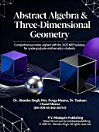
Integral Calculus, Geometry and Vector Calculus: A comprehensive class notes as per new education policy and syllabus of Maharaja Surajmal Brij University (MSBU) Bharatpur (Raj.), covering Integral Calculus, Geometry and Vector Calculus
About this ebook
This book is meticulously designed to align with the Integral Calculus, Geometry, and Vector Calculus curriculum prescribed by Maharaja Surajmal Brij University (MSBU), Bharatpur. Aimed at B.Sc. Mathematics students, it offers a harmonious blend of rigorous theory, practical applications, and illustrative examples, fostering a deep understanding of both computational techniques and geometric intuition.
The content is thoughtfully organized into four comprehensive units:
Unit I: Gamma and Beta Functions – This unit introduces students to the fundamental concepts of special functions and multiple integrals. Topics include Euler’s functional equation, properties and transformations of gamma and beta functions, and the evaluation of double and triple integrals using Dirichlet’s formula. These concepts form the bedrock for advanced integration techniques and problem-solving strategies in higher mathematics.
Unit II: Rectification and Quadrature – Focused on the application of integral calculus to geometry, this unit guides students in computing lengths, areas, and volumes of curves and solids. Key applications include Cartesian and polar curves, quadrature, solids of revolution, and Pappus’s theorem, along with triple integrals. Emphasis is placed on connecting algebraic computations with geometric visualization to enhance intuitive understanding.
Unit III: 3D Geometry — Sphere, Cone, and Cylinder – This unit delves into the geometry of three-dimensional objects. Students explore tangent and polar planes, representations of cones, standard forms of cylinders, and central conicoids. The unit emphasizes spatial reasoning, analytical geometry techniques, and their relevance in vector calculus and advanced applications.
Unit IV: Vector Calculus – The final unit introduces vector differentiation and integration, covering directional derivatives, gradients, divergence, curl, and vector identities. Applications of Gauss’s, Stokes’s, and Green’s theorems are presented (without proofs) to illustrate practical utility in physics and engineering contexts. This unit equips students with the tools to analyze vector fields and understand multi-dimensional phenomena.
Throughout the book, clarity, precision, and conceptual understanding are emphasized. Each topic is supplemented with worked examples, illustrative diagrams, and step-by-step derivations to reinforce learning. Exercises at the end of sections encourage practice and mastery, enabling students to develop problem-solving skills while building a strong foundation for advanced studies in mathematics.
This book serves not only as a comprehensive academic resource but also as a practical guide for cultivating analytical thinking and geometric intuition, making it an essential companion for undergraduate mathematics students aspiring to excel in both coursework and competitive examinations.
Discover more
Ratings and reviews
About the author
Dr. Jitendra Singh is an Associate Professor of Mathematics at Raj Rishi College, Alwar, affiliated with Raj Rishi Bhartrihari Matsya University, Rajasthan. He earned his Ph.D. from the University of Rajasthan (2016) and has been teaching since 2008, with extensive research in Operations Research. A dedicated educator and author, Dr. Singh has written textbooks for undergraduates and competitive exam guides for lecturers, NET JRF candidates, and various entrance exams. As a Board of Studies (B.O.S.) member, he has contributed to curriculum development. With expertise in mathematics education and research, Dr. Singh continues to shape the academic landscape.