About this ebook
A study of the structure, growth, and future of transnational human travel and communication
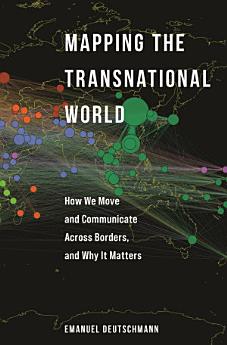
Increasingly, people travel and communicate across borders. Yet, we still know little about the overall structure of this transnational world. Is it really a fully globalized world in which everything is linked, as popular catchphrases like “global village” suggest? Through a sweeping comparative analysis of eight types of mobility and communication among countries worldwide—from migration and tourism to Facebook friendships and phone calls—Mapping the Transnational World demonstrates that our behavior is actually regionalized, not globalized.
Emanuel Deutschmann shows that transnational activity within world regions is not so much the outcome of political, cultural, or economic factors, but is driven primarily by geographic distance. He explains that the spatial structure of transnational human activity follows a simple mathematical function, the power law, a pattern that also fits the movements of many other animal species on the planet. Moreover, this pattern remained extremely stable during the five decades studied—1960 to 2010. Unveiling proximity-induced regionalism as a major feature of planet-scale networks of transnational human activity, Deutschmann provides a crucial corrective to several fields of research.
Revealing why a truly global society is unlikely to emerge, Mapping the Transnational World highlights the essential role of interaction beyond borders on a planet that remains spatially fragmented.
A study of the structure, growth, and future of transnational human travel and communication
Increasingly, people travel and communicate across borders. Yet, we still know little about the overall structure of this transnational world. Is it really a fully globalized world in which everything is...
Discover more
About the author
Emanuel Deutschmann is assistant professor of sociological theory at the University of Flensburg and an associate at the European University Institute’s Migration Policy Centre. Twitter @edeutschma
Emanuel Deutschmann is assistant professor of sociological theory at the University of Flensburg and an associate at the European University Institute’s Migration Policy Centre. Twitter @edeutschma
Rate this ebook
Tell us what you think.
Reading information
Smartphones and tablets
Install the Google Play Books app for Android and iPad/iPhone. It syncs automatically with your account and allows you to read online or offline wherever you are.
Laptops and computers
You can listen to audiobooks purchased on Google Play using your computer's web browser.
eReaders and other devices
To read on e-ink devices like Kobo eReaders, you'll need to download a file and transfer it to your device. Follow the detailed Help Center instructions to transfer the files to supported eReaders.