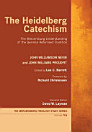
The Early Creeds: The Mercersburg Theologians Appropriate the Creedal Heritage

· Mercersburg Theology Study Series Book 8 · Wipf and Stock Publishers
Ebook
296
Pages
Tools
Eligible

About this ebook

This volume is a collection of essays on the early creeds by John Nevin and Philip Schaff, the two principal representatives of the Mercersburg Theology that was birthed in nineteenth-century Pennsylvania. It also contains a critical response by John Proudfit, a more traditionally scholastic Calvinist. In these essays Nevin and Schaff argued that the early creeds provide an indispensable lens through which the Bible should be interpreted and an essential bond to preserve the unity of the church through the centuries. According to these Mercersburg theologians the liturgical and confessional use of the early creeds is crucial for shaping the identity of Christians and mediating the life of Christ to believers. Nevin and Schaff's enthusiasm for the creeds was a function of their understanding of Christianity as an evolving tradition, the Christian life as growth in Christ-likeness, the church as the nurturing body of Christ, and the sacraments as conduits of Christ's vivifying personhood. These convictions stood in sharp contrast to the a-creedal sensibilities of most nineteenth-century American Protestants who emphasized the sufficiency of Scripture alone, the church as a gathered community of like-minded individuals, dramatic conversion experiences, and the direct presence of Christ to the individual soul.
This volume is a collection of essays on the early creeds by John Nevin and Philip Schaff, the two principal representatives of the Mercersburg Theology that was birthed in nineteenth-century Pennsylvania. It also contains a critical response by John Proudfit, a more traditionally scholastic Calv...

Discover more

About the author

Sam Hamstra Jr. is the Affiliate Professor of Church History and Worship at Northern Seminary. He is the editor of several studies, most recently The Reformed Pastor: Lectures on Pastoral Theology by John Williamson Nevin, and has authored several works on worship, including What’s Love Got to Do With It? How the Heart of God Shapes Worship. John Williamson Nevin (1803–1886), professor successively at Western Theological Seminary, the Theological Seminary of the German Reformed Church at Mercersburg, and Franklin and Marshall College. He was a leading nineteenth-century theologian and founding editor of Mercersburg Review.

Philip Schaff (1819-1893), American theologian and church historian, was born in Chur, Switzerland on the fist of January, 1819. He was educated at the gymnasium of Stuttgart, and at the universities of Tuebingen, Halle, and Berlin, where he was successively influenced by Baur, Tholuck, and Neander. In 1843 he became Professor of Church History and Biblical Literature at the German Reformed Theological Seminary of Mercersburg, Pennsylvania. His inaugural address on The Principle of Protestantism, delivered in German at Reading, Pennsylvania, in 1844, and published in German with an English version by J. W. Nevin, was a pioneer work in the field of symbolics.

Charles Yrigoyen Jr., a prominent pastor, teacher, and scholar, has written numerous books and articles on the history of Methodism and on the Mercersburg Theology. He has coedited two volumes of the highlights of the Mercersburg Theology: Catholic and Reformed: Selected Theological Writings of John Williamson Nevin, and Reformed and Catholic: Selected Theological Writings of Philip Schaff.

Lee C. Barrett is Stager Professor of Theology at Lancaster Theological Seminary. He is the author of The Heidelberg Catechism (2007), Foundations of Modern Theology: Kierkegaard (2009), and co-editor of Kierkegaard and the Bible (2010).
Sam Hamstra Jr. is the Affiliate Professor of Church History and Worship at Northern Seminary. He is the editor of several studies, most recently The Reformed Pastor: Lectures on Pastoral Theology by John Williamson Nevin, and has authored several works on worship, including What’s Love Got to Do...

Rate this ebook

Tell us what you think.

Reading information

Smartphones and tablets
Install the Google Play Books app for Android and iPad/iPhone. It syncs automatically with your account and allows you to read online or offline wherever you are.
Laptops and computers
You can listen to audiobooks purchased on Google Play using your computer's web browser.
eReaders and other devices
To read on e-ink devices like Kobo eReaders, you'll need to download a file and transfer it to your device. Follow the detailed Help Center instructions to transfer the files to supported eReaders.