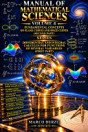
Manual of Mathematical Sciences - Volume 3
About this ebook
The book covers Sections 267–345 and is divided into three major thematic areas: the continuation of differential calculus, the study of integral calculus, and an introduction to the properties of plane and space curves. The sequence of topics connects the results already developed in the study of derivatives with new analytical methods and their applications.
Further Developments in Differential Calculus
The first part continues the study of differential calculus. It examines further aspects of the behaviour and properties of functions, together with analytical procedures, focusing on maximum and minimum points and on criteria for interpreting the behaviour of functions. Readers are guided towards understanding the role of differential tools in the qualitative study of functions and in solving mathematical problems.
Integral Calculus
A central part of the volume is devoted to integral calculus, presented as a natural development of differential calculus. The discussion addresses the meaning of integration, its principal techniques and the conditions governing their application. It also includes the study of improper integrals and cases involving discontinuous functions, extending the analysis beyond the most elementary situations.
The volume also examines numerical integration procedures, including the rectangle, trapezoidal and Simpson's rules. These methods illustrate how approximation techniques can be used to tackle problems for which the direct evaluation of an integral may be difficult or impracticable.
Areas and Geometrical Applications
The connection between analysis and geometry is developed through the study of areas in Cartesian coordinates. Integration is therefore considered not only as an analytical procedure but also as a tool for determining geometrical quantities, highlighting the relationship between analytical formulation, graphical representation and problem-solving.
An Introduction to Plane and Space Curves
The final thematic area introduces fundamental concepts in the differential geometry of plane and space curves. It begins the analytical study of curves and their characteristics, preparing readers to understand the mathematical tools used to describe shapes, directions and geometrical properties in space.
A Structured Guide for Study and Reference
The numbered-section structure makes the volume suitable both for systematic reading and for targeted reference. The discussion connects definitions, properties, computational methods and geometrical interpretations, providing a unified overview of topics that are often studied separately. Readers can follow the development of the concepts and identify the links between the different areas of mathematical analysis.
Volume 3 continues and expands the scope of the Mathematical Sciences Manual while maintaining the systematic approach that characterises the series: an ordered progression of topics designed to support learning, revision and further study.
Who This Volume Is For
This volume is intended for students, mathematics enthusiasts, independent learners and readers wishing to consolidate or deepen their knowledge of mathematical analysis. It can be used both as a study text and as a reference work by anyone seeking to explore differential calculus, integral calculus and the introductory elements of differential geometry through a coherent, progressive structure.
Edition 1.1