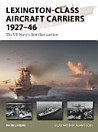
Lexington-Class Aircraft Carriers 1927–46: The US Navy's first fleet carriers
Nov 2026 · Bloomsbury Publishing
Ebook
48
Pages
About this ebook
This fully illustrated study explores the history of the Lexington class, the US Navy's first fleet carriers, from their battlecruiser origins to their service in World War II.
The Lexington class began life as two of the six battlecruisers ordered for the US Navy in 1916. Laid down in 1920–21, they would have been the most powerful battlecruisers ever, if the Washington Naval Treaty had not scrapped the world's newest capital ships. However, as a handful of hulls were permitted to become aircraft carriers, Lexington and Saratoga were spared for conversion.
Naval historian Mark Lardas explains how the resulting design was unprecedented. When built they were the largest carriers in existence – the US Navy would not have bigger carriers until the 1945 Midway class. They were fast, they carried larger air groups than any other carrier of their time, and they pioneered a flight deck design that became standard in all future carriers. During the 1930s, they were at the heart of the fleet exercises that developed US carrier doctrine.
Illustrated with archive photos and superb artwork of the ships through their careers, this book also explores their wartime service. Lexington took part in the carrier raids of early 1942 before being sunk at Coral Sea, while Saratoga fought in many of the key Pacific campaigns, developing night carrier operations in 1944 and 1945, before being sunk as an A-bomb target in Operation Crossroads.
This fully illustrated study explores the history of the Lexington class, the US Navy's first fleet carriers, from their battlecruiser origins to their service in World War II.
The Lexington class began life as two of the six battlecruisers ordered for the US Navy in 1916. Laid down in 1920–21, ...
Discover more
About the author
Mark Lardas has always been fascinated by things related to the sea and sky. From building models of ships and aircraft as a teen, he then studied Naval Architecture and Marine Engineering, but his interest in aviation led him to take a job on the then-new Space Shuttle program, where he worked for the next 30 years as a navigation engineer. Currently he develops commercial aircraft systems as a quality assurance manager. He has written numerous books on military, naval or maritime history.
Mark Lardas has always been fascinated by things related to the sea and sky. From building models of ships and aircraft as a teen, he then studied Naval Architecture and Marine Engineering, but his interest in aviation led him to take a job on the then-new Space Shuttle program, where he worked f...
Rate this ebook
Tell us what you think.
Reading information
Smartphones and tablets
Install the Google Play Books app for Android and iPad/iPhone. It syncs automatically with your account and allows you to read online or offline wherever you are.
Laptops and computers
You can listen to audiobooks purchased on Google Play using your computer's web browser.
eReaders and other devices
To read on e-ink devices like Kobo eReaders, you'll need to download a file and transfer it to your device. Follow the detailed Help Center instructions to transfer the files to supported eReaders.