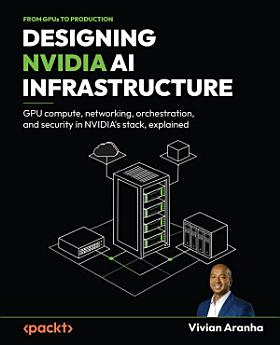
Designing NVIDIA AI Infrastructure: GPU compute, networking, orchestration, and security in NVIDIA's stack, explained

· Packt Publishing Ltd
Ebook
134
Pages
Tools

About this ebook

Navigate NVIDIA's enterprise AI infrastructure with confidence, from GPUs and data movement to orchestration, security, monitoring, edge systems, and model serving.Key Features
  • Build career-relevant knowledge of the NVIDIA AI infrastructure stack
  • Make informed architecture decisions for performance, scalability, security, and cost
  • Learn through practical configurations, deployment patterns, and enterprise case studies
Book DescriptionDesigning NVIDIA AI Infrastructure is a concise reference guide for professionals who want to develop career-relevant knowledge of GPU-powered platforms without working through a lengthy manual. The book explains how CPUs, GPUs, DPUs, storage, networking, software, and orchestration combine to support AI workloads. You will explore MIG and vGPU resource models, Kubernetes and Slurm scheduling, data pipelines, performance profiling, monitoring, TensorRT optimization, multi-tenant security, and governance. You will also learn how NVIDIA Jetson and Orin support edge AI and how NGC and Triton Inference Server contribute to model deployment and scalable serving. Selected commands, configuration examples, architecture diagrams, and enterprise scenarios connect these technologies to operational contexts. By the end, you will be able to discuss the NVIDIA AI infrastructure stack with greater confidence, evaluate common design choices and bottlenecks, and use the book as a quick reference when planning cloud, on-premises, hybrid, and edge AI environments.What you will learn
  • Understand what MIG and vGPU isolate and what they don't
  • Distinguish RBAC, network policy, and encryption's separate roles
  • See how storage, NVLink, and InfiniBand affect GPU utilization
  • Recognize where Kubernetes tools' responsibilities stop
  • Understand how GDPR, HIPAA, and FedRAMP shape AI infrastructure controls and evidence
  • Use GPU profiling and telemetry data to investigate bottlenecks
  • Learn how NGC, Triton, and ensembles fit a serving pipeline
  • Compare on-prem, cloud, and hybrid AI cluster trade-offs
Who this book is for

This book is for infrastructure engineers, ML and MLOps engineers, solutions architects, and technical leads who need a reliable mental model of NVIDIA’s AI infrastructure stack before designing, evaluating, or securing a GPU platform. It also suits professionals moving into AI infrastructure roles. Familiarity with Linux, containers, networking, cloud computing, or Kubernetes is helpful; advanced model-development knowledge and access to enterprise GPU hardware are not required.

Navigate NVIDIA's enterprise AI infrastructure with confidence, from GPUs and data movement to orchestration, security, monitoring, edge systems, and model serving.Key Features Build career-relevant knowledge of the NVIDIA AI infrastructure stack Make informed architecture decisions for performan...

Discover more

About the author

Vivian Aranha is an AI educator, technology leader, and founder of School of AI, with over 20years of industry experience. He earned a bachelor's degree in Information Technology in 2004and a master's degree in Computer Science in 2006. His career spans web technologies, mobile app development for iOS and Android, blockchain solutions, and AI systems and applications. Vivian has worked with Fortune 500 organizations, including The Washington Post, Delta AirLines, and IBM. An instructor since 2009, he has trained professionals worldwide and now teaches AI globally. His courses have attracted over 2.5 million enrolments, with more than500,000 students learning through School of AI, Udemy, Skool, and Maven.

Vivian Aranha is an AI educator, technology leader, and founder of School of AI, with over 20years of industry experience. He earned a bachelor's degree in Information Technology in 2004and a master's degree in Computer Science in 2006. His career spans web technologies, mobile app development fo...

Rate this ebook

Tell us what you think.

Reading information

Smartphones and tablets
Install the Google Play Books app for Android and iPad/iPhone. It syncs automatically with your account and allows you to read online or offline wherever you are.
Laptops and computers
You can listen to audiobooks purchased on Google Play using your computer's web browser.
eReaders and other devices
To read on e-ink devices like Kobo eReaders, you'll need to download a file and transfer it to your device. Follow the detailed Help Center instructions to transfer the files to supported eReaders.