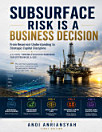
About this ebook
They fail because technically valid studies are translated into development decisions without defining the operational and economic boundaries that determine whether a project can actually survive reality.
Across the oil and gas industry, asset teams routinely produce sophisticated appraisal work: volumetric estimates, reservoir simulations, probabilistic forecasts, recovery factor ranges, and development concepts built on technically defensible assumptions. Yet projects still suffer from oversized facilities, premature water breakthrough, underperforming plateau rates, escalating operating costs, delayed compression requirements, and capital destruction that was never identified during the study phase.
This book examines the structural gap between subsurface analysis and executable decision-making.
Rather than focusing only on geology or reservoir engineering theory, WHY GOOD SUBSURFACE STUDIES STILL FAIL introduces a practical framework for transforming appraisal studies into decision-ready development architecture. It explains why P10/P50/P90 ranges are frequently misunderstood, how economic thresholds disappear between workflows, why uncertainty often becomes disconnected from facility design, and how organizations unintentionally approve development concepts that were never robust to begin with.
Using realistic field-development scenarios, decision frameworks, uncertainty translation methods, and capital exposure mapping approaches, this book provides a structured methodology for:
- Converting uncertainty into operational boundaries
- Defining economic floors before capital commitment
- Stress-testing development concepts against subsurface variability
- Linking appraisal outcomes to executable decisions
- Identifying hidden sources of capital fragility
- Building decision-ready subsurface workflows for marginal and mature assets
Written for geoscientists, reservoir engineers, asset managers, development planners, technical assurance teams, and upstream decision-makers, this book bridges the gap between technical rigor and capital discipline.
This is not a book about generating better studies.
It is a book about making better decisions from the studies already being produced.
Discover more
Ratings and reviews

- Flag inappropriate

- Flag inappropriate
About the author
Andi Anriansyah is a Senior Subsurface Professional - Oil & Gas Development with 17+ years of experience in subsurface geology, appraisal, and development support across operator, non-operator, and consulting settings. His work spans onshore and shallow-water fields across multiple basins in Indonesia and internationally, with a focus on subsurface evaluation, resource development planning, and decision-quality integration in upstream oil and gas.
He has worked with operators ranging from majors to independents across multiple geographies in Indonesia, contributing subsurface input to development planning, investment preparation, and execution decisions alongside reservoir engineers, drilling teams, and asset managers. His career has been defined by work at the intersection of subsurface technical work and investment decision-making — the translation layer that this book addresses.
His specific focus has been on the structural failures that cause technically sound appraisal work to produce development decisions that the subsurface evidence could not properly support. He has designed decision-quality governance frameworks, led study translation audits for investment committees, and developed the conversion frameworks that form the analytical core of this book.