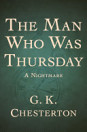
The Man Who Was Thursday
About this ebook
Dive into a newly restored edition of G. K. Chesterton's surreal masterpiece—one of the strangest and most enduring detective novels ever written.
A century before modern conspiracy thrillers, G. K. Chesterton created a dazzling nightmare of secret societies, shifting identities, and grand questions.
First published in 1908, The Man Who Was Thursday is a dazzling blend of espionage thriller, satire, and philosophical mystery. The story follows Gabriel Syme, recruited by Scotland Yard to infiltrate a secret council of anarchists whose members are each named for a day of the week. What begins as a clever undercover mission soon spirals into a bewildering chase of disguises, reversals, and deeper questions about order, chaos, and the nature of evil.
A precursor to the modern speculative thriller, Chesterton's novel has fascinated readers for more than a century. This fine new edition presents a carefully prepared text and includes a new foreword by Steve Ruskin, offering fresh insight into one of the most imaginative works of early twentieth-century literature. Read what a member of the Chesterton society once called "A great way to start an argument."
Discover more
About the author
G. K. Chesterton (1874–1936)
Gilbert Keith Chesterton was an English writer, essayist, poet, and critic whose work combined intellectual rigor with exuberant wit. Born in London in 1874, he was educated at University College London and trained in art before turning to journalism and literature. Over the course of his career, Chesterton wrote nearly one hundred books and thousands of essays on subjects ranging from politics and theology to detective fiction and literary criticism.
Chesterton rose to prominence as a public intellectual in Edwardian England, a period marked by rapid social change and deep philosophical uncertainty. While many of his contemporaries embraced skepticism, materialism, or political extremism, Chesterton argued for the enduring value of tradition, moral limits, and religious belief. He became famous for his use of paradox, insisting that what modern thinkers dismissed as "common sense" often concealed deeper wisdom.
Though widely read for his essays and debates, Chesterton is also remembered as a pioneering writer of fiction. His novels and stories blend fantasy, satire, and philosophy, most notably in The Man Who Was Thursday (1908) and the Father Brown detective stories. These works explore themes of identity, justice, illusion, and the hidden order of the world.
Chesterton converted to Roman Catholicism in 1922, though much of his most influential writing predates this decision and reflects a long period of spiritual inquiry. Throughout his life, he maintained a generous and humane approach to disagreement, believing that ideas mattered because people mattered.
He died in 1936, leaving behind a body of work that continues to challenge readers to think more clearly, imagine more boldly, and recover a sense of wonder in the everyday world.