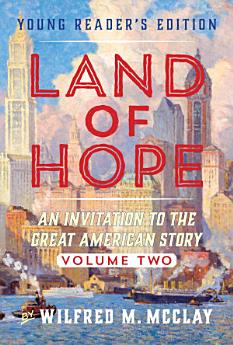
Land of Hope Young Reader's Edition: An Invitation to the Great American Story, Volume Two
About this ebook
This is Volume 2 of the two-volume Young Reader’s Edition of Land of Hope, primarily intended for grades 6–8.
Volume Two: The Making of Modern America, from 1877 to 2020
The Founders of the American nation would have had trouble recognizing the America that emerged after the Civil War. By century’s end we had rapidly evolved into the world’s greatest industrial power. It was a nation of large new cities populated by immigrants from all over the world. And it was a nation that was taking an increasingly active role on the world stage, even to the point of acquiring an empire of its own. Many Americans began to wonder whether this modern nation had outgrown its original Constitution. That document had been written back in the eighteenth century, after all, and one of its main goals was limiting the size and scope of government. But did that goal make sense in the dynamic new America of the twentieth century?
That became a central question. The Progressive movement and its successors believed it was time to replace the Constitution with laws permitting a larger and more powerful government. Others firmly rejected such changes and insisted on the permanent validity of the Constitution’s ideal of limited government. In addition, with the two great world wars of the twentieth century, and the Cold War that came after them, America found itself thrust into a position of overwhelming world leadership—something else that the Founders never imagined or wanted. Such leadership required the development of a large and permanent military establishment whose very existence ran up against the nation’s founding traditions. With the end of the Cold War, America faced a decision. Should it shed the world responsibilities it had taken on during the twentieth century? Or should it treat those responsibilities as a permanent obligation? That debate, which has deep roots in American history, continues to this day.
How to Use It
- Read the volumes in order. Volume 1 covers 1492 to 1877.
- Teachers: the Teacher’s Guide, Volume 2, provides chapter summaries, answers, key names and terms, crossword puzzles, primary sources, and map keys.
- Students: the Student Workbook, Volume 2, provides reading questions, primary sources, and map exercises; the answers are in the Teacher’s Guide.
Choosing the Right Edition
- Young Reader’s Edition: A two-volume adaptation primarily intended for grades 6–8, with dedicated Teacher’s Guides and Student Workbooks. (This book.)
- Second Edition, Revised and Illustrated: The expanded and updated edition, with primary sources, maps, artwork, and chronologies.
- Original Edition: For general readers and for high school and college courses. Compatible with the original Teacher’s Guide and Student Workbook.
Teaching materials are edition-specific; please select the guides and workbooks that correspond to your book.
Discover more
Ratings and reviews

- Flag inappropriate
About the author
Wilfred M. McClay holds the Victor Davis Hanson Chair in Classical History and Western Civilization at Hillsdale College. Before coming to Hillsdale in the fall of 2021, he was the G.T. and Libby Blankenship Chair in the History of Liberty at the University of Oklahoma, and the Director of the Center for the History of Liberty. His book The Masterless: Self and Society in Modern America received the 1995 Merle Curti Award of the Organization of American Historians for the best book in American intellectual history. Among his other books are The Student’s Guide to U.S. History; Religion Returns to the Public Square: Faith and Policy in America; Figures in the Carpet: Finding the Human Person in the American Past; Why Place Matters: Geography, Identity, and Public Life in Modern America; and Land of Hope: An Invitation to the Great American Story.
He served for eleven years on the National Council on the Humanities, the advisory board for the National Endowment for the Humanities, and served on the U.S. Commission on the Semiquincentennial, which planned the celebration of the nation’s 250th birthday in 2026. He has been the recipient of fellowships from the Woodrow Wilson International Center for Scholars, the National Endowment for the Humanities, and the National Academy of Education, and served as a Fulbright Senior Lecturer in American History at the University of Rome. He is a graduate of St. John’s College (Annapolis) and received his Ph.D. in History from Johns Hopkins University.