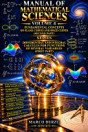
Manual of Mathematical Sciences - Volume 2
About this ebook
Covering sections 146–266, this volume is designed as a coherent continuation of the first volume. Its discussion moves from geometric objects and relationships in space to the concepts used to describe the behavior of functions, understand their variation, and address the principal problems of differential calculus.
ANALYTIC GEOMETRY IN SPACE – PART TWO
The first part completes and develops the study of analytic geometry in space. It examines the relationships between lines and planes, with particular attention to angles, conditions for parallelism and perpendicularity, and the analytical procedures required to describe and solve three-dimensional geometric problems. The material strengthens the use of coordinates and vector tools, showing how algebraic language makes it possible to interpret spatial configurations with precision and method.
INTRODUCTION TO MATHEMATICAL ANALYSIS AND REAL FUNCTIONS
The volume then broadens its scope to mathematical analysis, a fundamental discipline for studying variable quantities and phenomena described by functions. Readers are guided through real-valued functions of a real variable, their properties, and their behavior, progressively building the conceptual framework needed to understand limits and continuity.
SEQUENCES, LIMITS, AND CONTINUITY
A central part of the volume is devoted to limits and continuity, essential tools for describing the behavior of a function near a point or as the variable approaches particular values. The discussion considers the meaning of limits, conditions for their existence, one-sided limits, and cases of discontinuity, accompanying the theoretical presentation with examples, summary outlines, and exercises.
DERIVATIVES AND DIFFERENTIAL CALCULUS
The journey continues with the study of the derivative, understood both as an analytical tool and as a measure of the instantaneous rate of change of a function. Topics include the geometric meaning of the derivative, differentiation rules, derivatives of elementary and composite functions, higher-order derivatives, and applications to the study of the local and global behavior of functions. Particular emphasis is placed on the connection between algebraic calculation, geometric interpretation, and the analysis of function properties.
FUNDAMENTAL THEOREMS AND THEIR APPLICATIONS
The discussion includes important results of differential calculus, among them Rolle’s theorem, the Mean Value Theorem of Lagrange, the formula for finite increments, and the generalized Mean Value Theorem, known as Cauchy’s Mean Value Theorem. For each result, the statement, hypotheses, meaning, interpretation, and consequences are explored through proofs and worked applications, with careful attention to the conditions required for correct use.
A STRUCTURE DESIGNED FOR STUDY AND REFERENCE
The organization into numbered sections and subsections makes it possible to approach the topics progressively and to locate definitions, properties, procedures, and theorems with ease. Worked examples, summaries, exercises, and their solutions or solution outlines help connect theoretical understanding with practical application. Figures and visual representations make geometric concepts and mathematical interpretations easier to follow.
Edition 1.1