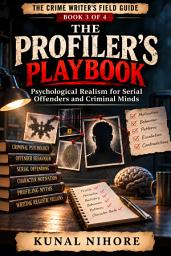
The Crime Writer’s Field Guide
About this ebook series
The Crime Writer’s Field Guide
Write Convincing Crimes. Build Believable Investigations. Create Unforgettable Mysteries.
A compelling crime story needs more than a clever culprit, a shocking discovery, or a last-minute confession. It needs an investigation that makes sense, evidence that has believable limitations, characters who behave like real people, and a justice system that feels authentic.
The Crime Writer’s Field Guide is a practical nonfiction series for crime novelists, mystery writers, thriller authors, screenwriters, and aspiring storytellers who want to bring greater realism to their crime fiction.
Whether you are writing a police procedural, psychological thriller, detective mystery, courtroom drama, or serial-offender narrative, this series helps you understand the investigative and psychological elements behind convincing crime stories.
Each book explores a specialised aspect of crime-fiction storytelling, translating research-informed concepts into practical writing guidance. Discover how to construct believable investigations, develop realistic forensic details, write psychologically convincing interviews, create complex criminal characters, and portray legal proceedings without sacrificing narrative momentum.
Inside the series, you will explore:
Investigation Realism: Understand how criminal investigations develop, how evidence shapes a case, and how investigators work with uncertainty.
Forensic Storytelling: Portray physical and digital evidence, forensic limitations, documentation, and chain of custody without relying on unrealistic scientific shortcuts.
Psychological Characterisation: Develop believable offenders, motives, conflicting behaviours, and complex antagonist characters without reducing people to stereotypes.
Interview and Confession Scenes: Create compelling suspect interviews through dialogue, conflicting accounts, uncertainty, character psychology, and dramatic tension.
Legal and Procedural Accuracy: Understand the broader journey from investigation to prosecution and courtroom proceedings, while recognising that legal systems differ by jurisdiction.
Practical Writing Exercises: Apply every major concept through original scene prompts, planning frameworks, revision checklists, and authenticity audits.
The series is designed to be practical and accessible. Every book can be read independently, making it useful whether you are planning your first crime novel or revising an established manuscript.
The objective is not to turn writers into investigators, forensic specialists, or legal professionals. It is to help them make informed creative decisions, avoid common storytelling mistakes, and understand where realism strengthens a story—and where artistic invention is necessary.
From the first discovery of a crime to the final courtroom revelation, The Crime Writer’s Field Guide gives writers a structured way to build crime fiction that is credible, suspenseful, and deeply engaging.
Understand the investigation. Build the evidence. Explore the criminal mind. Tell a better crime story.
The Crime Writer’s Field Guide — Practical realism for writers of crime, mystery, and suspense.