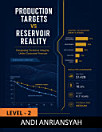
About this ebook
Yet many of these projects still fail — not technically, but economically.
This book examines a critical but often overlooked gap: the disconnect between technical analysis and economic outcomes. Drawing on real-world experience within multidisciplinary teams, it shows how uncertainty in subsurface models, cost estimates, schedules, and production assumptions is often simplified — or lost entirely — when translated into financial models and investment decisions.
Rather than presenting finance theory, this book offers a practical, structured way for engineers and technical professionals to understand how their work influences capital decisions. It explores how seemingly reasonable assumptions can compound into significant economic consequences, and why projects that appear technically sound can still destroy value.
Through clear explanations, realistic scenarios, and decision-focused frameworks, the book addresses:
- Why technical success does not guarantee commercial success
- How probability, reserves, and production assumptions are misinterpreted economically
- The hidden impact of cost escalation and schedule delays
- Why break-even and price assumptions are often misunderstood
- How incremental decisions accumulate into full capital exposure
- The role of human bias, organizational dynamics, and overconfidence in project outcomes
This is not a finance textbook. It is a decision-awareness guide for engineers, project teams, and professionals working at the intersection of technical analysis and capital allocation.
Because in the end, projects do not succeed based on technical correctness alone — but on how well technical reality is aligned with economic decisions.
Discover more
Ratings and reviews

- Flag inappropriate

- Flag inappropriate

- Flag inappropriate
About the author
Andi Anriansyah is a senior subsurface professional with more than 17 years of experience in oil and gas exploration, development, and field optimization, primarily within Indonesian operating environments.
His career has been shaped by working within multidisciplinary asset teams, contributing subsurface insight to field development planning, reserves and resource assessment, drilling and work programs, and recovery optimization initiatives. Across these roles, he has been closely involved in the interface between technical evaluation and project decision-making — where subsurface uncertainty is translated into production forecasts, development concepts, and ultimately economic outcomes.
Through his experience supporting projects across operator, consulting, and government-related environments, Andi has observed a recurring pattern: technically sound work does not always translate into economically successful outcomes. This observation — repeated across multiple projects and discussions — forms the foundation of this book.
Rather than approaching the subject as a financial specialist, Andi writes from the perspective of a technical practitioner who has worked alongside engineers, project teams, and management in navigating the realities of uncertainty, risk, and capital decision-making.
His focus is not on replacing engineering judgment with financial analysis, but on strengthening the connection between them — enabling technical professionals to better understand how their work influences economic outcomes, and how those outcomes can diverge from expectations when uncertainty is not fully translated.
This book reflects that perspective: grounded in real project environments, shaped by cross-functional collaboration, and driven by a practical need to improve how technical and economic thinking come together in capital decisions.