About this ebook
This book explores that transformation.
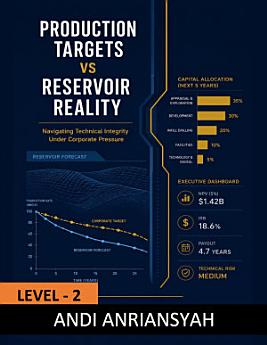
Production Targets vs Reservoir Reality examines the hidden tension between what reservoirs are physically capable of delivering and what organizations require them to deliver. Through realistic field scenarios, planning-room dynamics, probabilistic forecasting discussions, and practical communication frameworks, the book reveals how optimism accumulates inside technical organizations — and how even experienced engineers can gradually lose the distinction between realistic forecasting and institutional expectation.
Rather than treating forecasting failure as purely technical, this book approaches the problem as a combination of:
- reservoir engineering,
- decision psychology,
- corporate incentives,
- planning systems,
- and professional integrity.
Written for reservoir engineers, production engineers, asset managers, technical leaders, and energy executives, the book provides a practical framework for navigating:
- production target pressure,
- decline management,
- probabilistic forecasting,
- annual planning distortions,
- organizational optimism,
- and communication under uncertainty.
This is not a textbook about simulation models.
It is a professional field guide for technical professionals working inside high-pressure asset organizations where physics, capital, reputation, and organizational ambition collide.
Discover more
Ratings and reviews

- Flag inappropriate

- Flag inappropriate

- Flag inappropriate
About the author
The author is a senior subsurface professional with seventeen years of experience in oil and gas field evaluation, development planning, and technical advisory roles. Throughout a career spanning multiple Indonesian basins — including South Sumatra, NE Java, Salawati Basin, and North Sumatra — and international projects including work in Madagascar, he has contributed to multidisciplinary teams alongside reservoir engineers, production engineers, drilling engineers, and commercial planners. That proximity to every phase of the subsurface workflow is the foundation of the observations in this book.
Over seventeen years, the author has participated in the full cycle of subsurface work this book describes: contributing to production evaluations under annual target pressure, engaging in reserves discussions alongside reservoir engineering teams, preparing AFE and WP&B documentation in operator and joint-venture settings, and — in more recent roles — providing independent technical review to project and asset teams. He has experienced the pressure this book describes from multiple angles: as a technical specialist contributing within a multidisciplinary team, as a G&G member navigating organizational expectations alongside reservoir engineers and commercial planners, and as an independent advisor observing the same dynamics from the outside. The difference between fields that are well-managed and fields that are damaged by short-term pressure, in his observation, has come down less to technical capability than to the professional practices and communication disciplines this book describes.
The author currently works as a senior independent technical professional, providing subsurface evaluation, geological assessment, and technical decision support to operating companies and project teams — engaging across subsurface, development, and project dimensions without line authority. This advisory role, engaging flexibly with project and asset teams to support sound technical decision-making, is the vantage point from which the final chapters of this book were written.